
Analysis of the Homeopathic Similimum and Constitutional Vulnerabilities
Homeoceutics astrological analysis brings together the search for the similimum, constitutional remedy, homeopathic portraits, and a constitutional reading in one report. Using the date, time, and place of birth, followed by the place of residence, it proposes candidate remedies, priority body systems, and associated plants. Transit calculations add a view of how the model’s indicators change over time, with dates to explore.
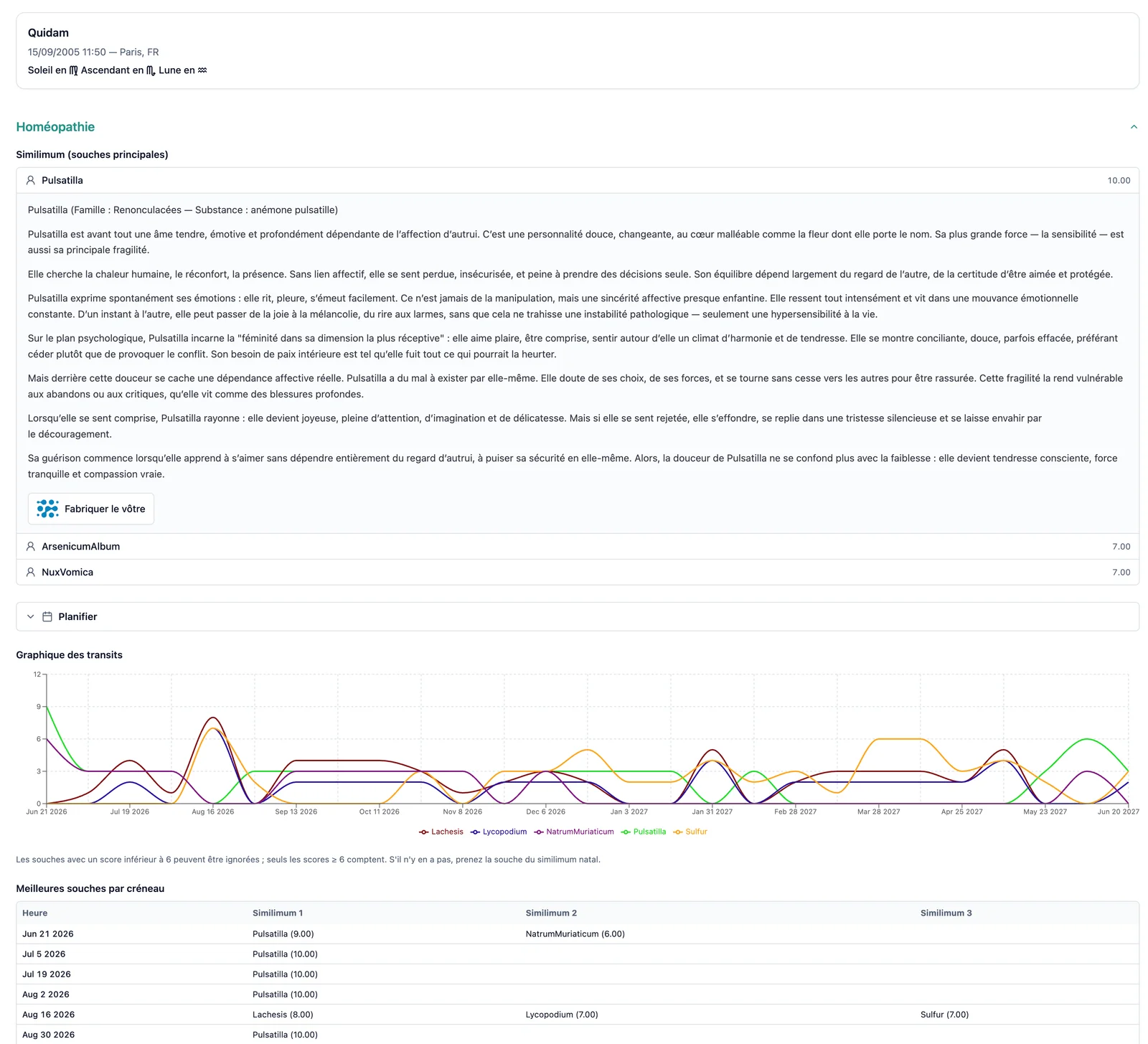
Homeoceutics astrological analysis brings together the search for the similimum, homeopathic portraits, and a constitutional reading in one report. Using the date, time, and place of birth, followed by the place of residence, it proposes candidate remedies, priority body systems, and associated plants. Transit calculations add a view of how the model’s indicators change over time, with dates to explore.
From the birth chart to the search for the similimum
The homeopathic section follows the astro-homeopathic method of Dr Franck Nguyen, presented in L’Astro-homéopathie — Grands et petits remèdes. This approach relates the birth chart’s characteristics to descriptions in Kent’s repertory to guide the search for a constitutional remedy. The complementary constitutional, transit, and gemmotherapy modules also draw on other references; they are not all attributed to Nguyen.
In homeopathic tradition, the similimum is the remedy whose portrait most closely matches a person’s overall characteristics. Homeoceutics ranks three candidates using the correspondences and weightings of its astrological model. This provides an organized selection for further reading, rather than relying on the Sun sign alone. The ranking does not replace a consultation with a practitioner, and its weights are not percentages indicating how closely a remedy matches the person.
Several portraits to enrich reflection
Each remedy provides access to a psychological portrait: ways of relating to others, sensitivity, responses to constraints, aspirations, and reactions described in homeopathic tradition. Several portraits may resonate with different aspects of someone’s experience. Comparing them can help formulate more precise questions and prepare a discussion with a practitioner, without reducing the person to a label.
Camille: a fictional birth, a real calculation
Consider Camille, a fictional person born on 17 March 1986 at 14:35 in Lyon, France, and living in Lyon. This example was calculated on 14 October 2026, with a twelve-month horizon running from 14 October 2026 to 14 October 2027. The chart has the Sun in Pisces, the Ascendant in Leo, and the Moon in Gemini. Here is an extract from the natal result:
Proposed remedy | Model weight |
|---|---|
Ignatia | 9 |
Phosphorus | 9 |
Sulfur | 9 |
In this instance, the three candidates are tied which sometimes occurs: no single remedy is identified as the sole winner. The practionner has to known Camille to pick one or several similimum, or Camille has to recognize herself in the portraits.
Ignatia evokes strong emotional sensitivity, sometimes concealed behind a desire for control and demanding expectations of oneself.
Phosphorus emphasizes openness, empathy, and receptiveness to the emotional atmosphere, with possible difficulty maintaining personal boundaries.
Sulfur describes curiosity, intellectual independence, and a need to understand, which may come with difficulty focusing when several ideas compete for attention.
These summaries describe traditional remedy portraits; they are not a psychological assessment of Camille.
For instance here is the Ignatia portrait :
Ignatia stands out for natural elegance, never showy, and a refined way of being in the world. It is a lively, cultivated, sensitive personality with a keen sense of identity and real concern for emotional harmony. It feels fully itself only when emotional balance is preserved.
Beneath assured airs, Ignatia hides great hypersensitivity to lack of love and a deep thirst for recognition. It faces life’s trials with courage and dignity, concealing inner suffering and the cost of this apparent mastery.
Ambitious and strong-willed, Ignatia seeks to prove its worth through achievement. It invests totally in what it undertakes, often to the point of competition, driven by a strong desire for excellence and social validation. For it nothing is lukewarm: everything is lived intensely, in black-and-white contrasts.
Ignatia embodies free thought and deep conviction. It is an engaged, passionate nature—sometimes assertive—a convinced feminist, or more broadly a soul fighting for sincerity and authenticity in its ideals. Each decision and action affirms self and values.
Behind this strength lies great emotional vulnerability. To avoid seeming weak, Ignatia suppresses gentleness and sensitivity, often repressing its tender, feminine side. This control helps it hold on but over time costs spontaneity and inner exhaustion.
Its need to master situations and “hold up” in all circumstances pushes it constantly past its limits. It prides itself on facing everything, even adversity, yet this constant demand eventually frailizes it. When the gap between ideal and reality grows too wide, Ignatia collapses: it realizes the perfect world it wanted does not exist, and effort has not filled the inner void.
In imbalance, reactions become nervous, unpredictable, often disproportionate. Its emotional system, sorely tried, shows the tension between control and sensitivity, pride and need for love.
At heart, Ignatia is the image of a noble, passionate soul torn between the desire for strength and the need for emotion—a personality both radiant and fragile, whose path to inner harmony passes through reconciling with its own vulnerability.
From constitutional priorities to gemmotherapy suggestions
The analysis also examines constitutional “weak links” and ranks body systems using an internal stress or attention score. The work of Jeffrey Wolf Green (Evolutionnary astrology) has been formalized. These terms belong to the astrological framework. The updated interface displays catalog plants associated with each system whose global score is strictly above 7.8, even when no weak link has been identified. Each card brings together the system, its score, common and botanical plant names, and any available details.
In Camille’s example, seven systems exceed this threshold. Here are three extracts with some suggested plants:
Endocrine / hormonal — 20: hawthorn (Crataegus oxyacantha), silver linden, and rosemary.
Nervous system — 20: hawthorn, black currant, fig (Ficus carica), and silver linden.
Bone — 14.04: field horsetail, silver fir, and giant sequoia (Sequoia gigantea).
The other scores concern the cardiovascular and auditory systems, each at 14.04, the digestive system at 11.15, and skin / integumentary at 8.85. Hawthorn and silver linden are among the plants associated with several priority systems. This presentation makes those overlaps easier to see.
Gemmotherapy uses buds and other young plant tissues. The displayed associations are possible supportive approaches drawn from the catalog, to discuss with a professional. They establish neither an actual weakness in the relevant system nor a plant’s effectiveness for the individual.
Transits: following changes over twelve months
Transits are the positions of planets over time, considered in relation to the birth chart. Homeoceutics uses them to plot changes in its indicators and date their peaks. The period starts on the calculation date: twelve months therefore does not necessarily mean a January-to-December calendar year. The curves help identify changes within the model and locate periods to examine.
Extract from Camille’s calculation: one weak link is selected, titled “Adrenal / inflammatory load under overdrive.” Its calculated peak falls on 7 July 2027. In the traditional section, every day in the period remains classified at the Low level.
These sections use different scales. A peak marks a maximum on a model’s curve; it does not predict an illness or establish a medical risk.
A report to explore and discuss in consultation
Portraits, suggestions by system, and graphs are brought together in a result accessible through the history. The report can be saved as a PDF to retain a reading or prepare for a consultation. From your eligible account, open the “Astrological analysis” module and choose your transit horizon. To discover the access requirements, see Homeoceutics subscriptions.